Title here
Summary here
The seller is responsible for all costs until the goods are delivered to the buyer at the destination. The seller doesn’t pay for unloading in DDP. Name the place of destination exactly. This term can be used for any mode of transportation. The seller must be able to clear customs at the destination.
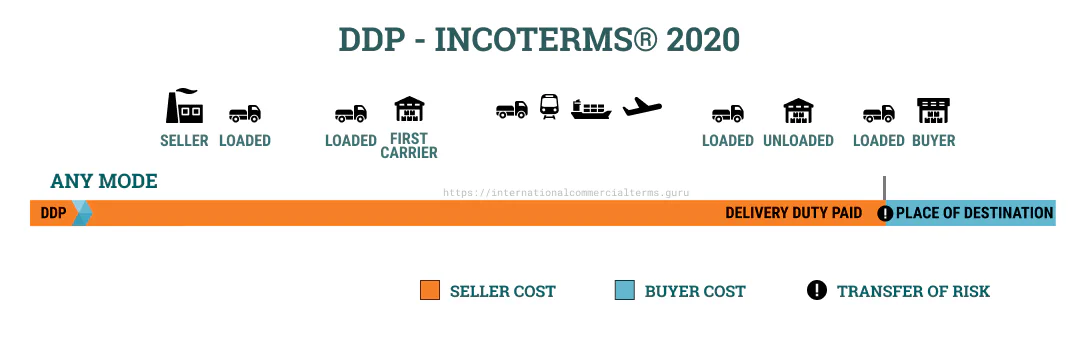
The seller delivers goods until the final point agreed with the buyer, with customs clearance paid and goods unloaded. It’s the riskiest for the seller. The seller must pay all taxes and charges. No insurance is needed, and it can be shipped by any method. The seller must know what to do when selling up to the final destination with all expenses covered. This is usually for items like courier, where the full supply chain cost is under control.
Courier delivery of online purchases:
DDP 445 Ocean Road, Sydney, Australia - Incoterms® 2020| THE SELLER’S OBLIGATIONS | THE BUYER’S OBLIGATIONS |
|---|---|
| A1. General The seller must deliver the goods, commercial invoice, and any evidence of conformity. | B1. General The buyer must pay the price of goods as agreed. |
| A2. Delivery Deliver the goods at the disposal of the buyer on the arriving vehicle, ready for unload. On the agreed date or period. | B2. Taking Delivery The buyer takes the goods at the destination point. |
| A3. Risks All risk of loss/damage until goods have been delivered. | B3. Risks All risk of loss/damage from the time or end of the period agreed for delivery. If the buyer fails to assist the import clearance, the risk is under the buyer. |
| A4. Carriage Contract carriage of goods until the place of destination. | B4. Carriage No obligation to contract a carrier. |
| A5. Insurance No obligation. | B5. Insurance No obligation to insure the goods. |
| A6. Delivery/transport document Provide documents that allow the buyer to take over the goods. | B6. Delivery/transport document Accepts the proof of delivery |
| A7. Export/Import clearance All export and import clearance expenses (license, security, inspection, etc). | B7. Export/Import clearance Assist with import clearance. |
| A8. Checking The seller must check, count, weight, mark, and package goods | B8. Checking No obligation. |
| A9. Allocation of cost Pay all the cost until delivery. Transport and loading. Unloading charges only if related to the contract of carriage. Cost of delivery/transport document. Duties and taxes for export and import. | B9. Allocation of cost Pay from the time goods delivered. Any additional cost if does not notify the time for taking delivery or fails to assist the seller for import clearance. |
| A10. Notices Give the notice to receive the goods. | B10. Notices Time or period for receiving the goods and name the point of receiving the goods. |
No. The term “door-to-door” has no official definition in Incoterms - the word “door” isn’t even mentioned in the Incoterms 2020 book.
Both DAP and DDP require a named place of delivery to be specified. The only difference between DAP and DDP concerns import clearance responsibilities and related costs - not the location of delivery.
Expert recommendation (Johnatas Montezuma): AVOID DDP AT ALL COSTS, OR IT MIGHT COST YOU DEARLY!
DDP is problematic and should be avoided in almost all circumstances, especially for cross-ocean transactions. Here’s why:
Legal issues:
Practical risks:
Better alternatives: Use DAP or other terms that don’t require the seller to handle import clearance in the destination country.
Under Incoterms 2020 DDP, the seller is NOT responsible for unloading at the named place of delivery. Only DPU (Delivered at Place Unloaded) explicitly requires the seller to unload.
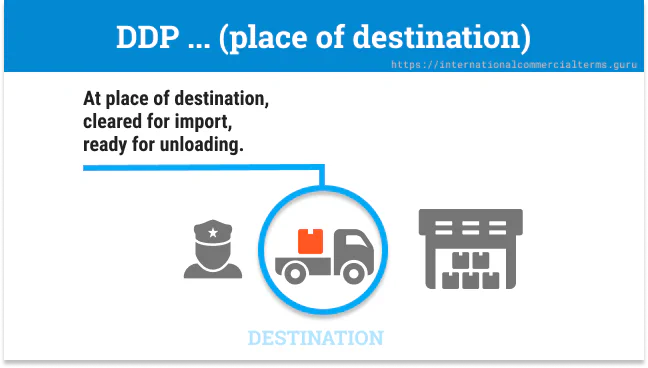
Delivery under DDP is completed when goods arrive at the named place of delivery, NOT unloaded, ready for unloading by the buyer.
Key points:
This depends on:
General principle: DDP Incoterms 2020 makes no mention of containers nor imposes any obligation on the seller to return empty containers. It is common practice for shipping lines to charge demurrage and detention charges to the consignee of the goods in the Bill of Lading.
If the named place is the destination terminal: The buyer would be responsible for taking the container from that terminal and returning it, as delivery by the seller would have occurred when the container was made available at the terminal, import cleared.
Important note: The question can only be answered once all facts are known. Incoterms don’t deal with the implications of the contract of carriage that contains details about detention charges.
Other considerations: