Title here
Summary here
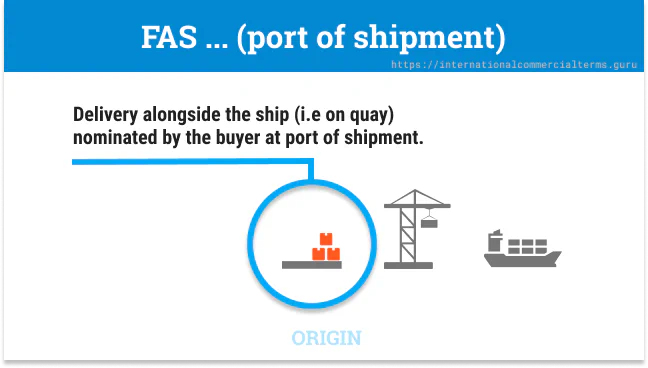
In a FAS transaction, the seller is responsible for clearing the goods for export and delivering them alongside the vessel nominated by the buyer at the port of origin. This means that the seller is liable for all costs and risks associated with the goods up to the point of delivery. This term applies only to ocean or inland waterway ports. If the goods are handed to the carrier in a container terminal, the more appropriate term is FCA.
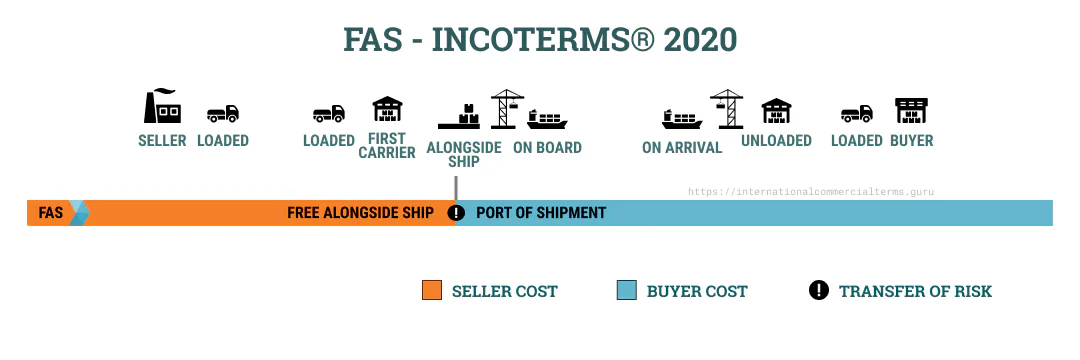
It is the responsibility of the seller to deliver the goods in question next to the vessel, with all necessary export customs clearance paperwork completed. FAS is a common method for handling out-of-gauge (OOG) cargo, which is defined as cargo that cannot fit into the internal dimensions of a container. This may include items such as boats or tractors. It should be noted that FAS can only be used for ocean cargo. Furthermore, the loading cost into the vessel must be under the seller’s account.
Due to the limited availability of time on the wharf, it is crucial to negotiate the specifics of the delivery, including the time and location, when using the FAS term. This term is also commonly used when purchasing liquids, which require the use of hoses for transfer (e.g., chemicals). It is advisable to specify the precise location within the port, particularly in large ports with multiple locations. The FAS term is frequently utilized in the sale of bulk commodities, such as grains or oil. In the event that the cargo is containerized, it is standard practice to deliver the goods to the carrier’s container yard or terminal (the FCA term is more suitable in this instance).
Buying a boat with pick up on 10th March before noon - Incoterms® 2020
FAS - Pier 10 Port of Miami Florida - Incoterms® 2020Buying a machine to corrugated boxes in different sets and parts, non-containerised:
FAS - Bremen Pier 2 - Incoterms® 2020| THE SELLER’S OBLIGATIONS | THE BUYER’S OBLIGATIONS |
|---|---|
| A1. General The seller must deliver the goods, commercial invoice, and evidence of conformity. | B1. General The buyer must pay the price of goods as agreed. |
| A2. Delivery Deliver the goods at the agreed point alongside the vessel nominated by the buyer, in the agreed date or period. If no time is notified, when goods have been loaded or placed at the disposal of the carrier | B2. Taking Delivery The buyer takes the goods after delivered. |
| A3. Risks All risk of loss/damage until goods have been delivered | B3. Risks All risk of loss/damage from the time or end of the period agreed for delivery. If the buyer fails to nominate a carrier, or if the carrier doesn’t arrive, the risk is under the buyer. |
| A4. Carriage No obligation to make a contract of carriage. Provide at buyers risk and cost, information for arranging carriage. If agreed, the seller must contract the carrier. | B4. Carriage Contract the carriage from the place of delivery unless agreed the seller will contract the carrier. |
| A5. Insurance No obligation. Provide at buyers risk and cost, any required information. | B5. Insurance No obligation to insure the goods. |
| A6. Delivery/transport document Proof of delivery at sellers cost and a transport document if arranged by seller | B6. Delivery/transport document Accepts the proof of delivery |
| A7. Export/Import clearance All export clearance expenses (license, security, inspection, etc). Assist with import clearance | B7. Export/Import clearance Assist with export clearance. Pay for import clearance and formalities (licenses, security, official documentation). |
| A8. Checking The seller must check, count, weight, mark, and package goods | B8. Checking No obligation. |
| A9. Allocation of cost Pay all the cost until delivery. Cost of proof of delivery. Duties and taxes for export. All costs related to providing assistance in obtaining documents to the buyer | B9. Allocation of cost Pay from the time goods delivered. All costs for assistance on get carriage, insurance, delivery, and customs documentation. Pay duties and taxes for import or transit. Any additional cost if the carrier is not nominated or carrier fails to collect goods. |
| A10. Notices Give notice that goods have been delivered or the vessel failed to collect the goods. | B10. Notices Notify the vessel name, loading point and time or period. |
The FAS rule does not specify this - it needs to be precisely defined in the underlying sales contract.
Considerations include:
Example:
Expert guidance: FAS needs the seller and buyer to agree in their sales contract exactly how and where delivery is to be achieved, as it’s likely dependent on the nature of the goods. There may not even be a crane - goods might be on some form of rolling mechanism. There is no “loading terminal” in FAS.
Usage note: FAS is rarely used and does not apply to containerized goods. Freight forwarders should almost never encounter it.