Title here
Summary here
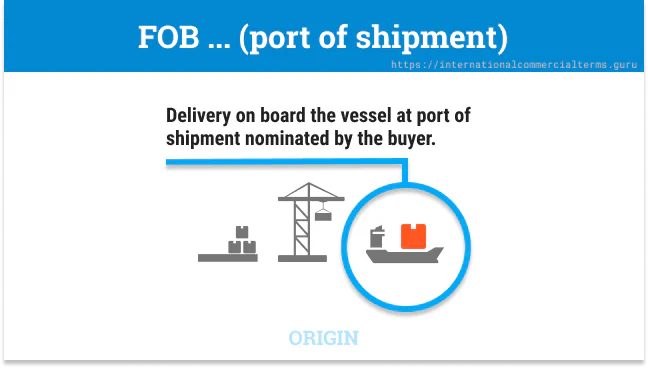
In a FOB transaction, the seller is responsible for clearing the goods for export and delivering them when they pass the ship’s rail at the agreed port. This term is exclusively applicable to water transportation, whether by sea or inland waterways. In the event that both parties do not agree to have the goods delivered on board, the appropriate term to be used is FCA.
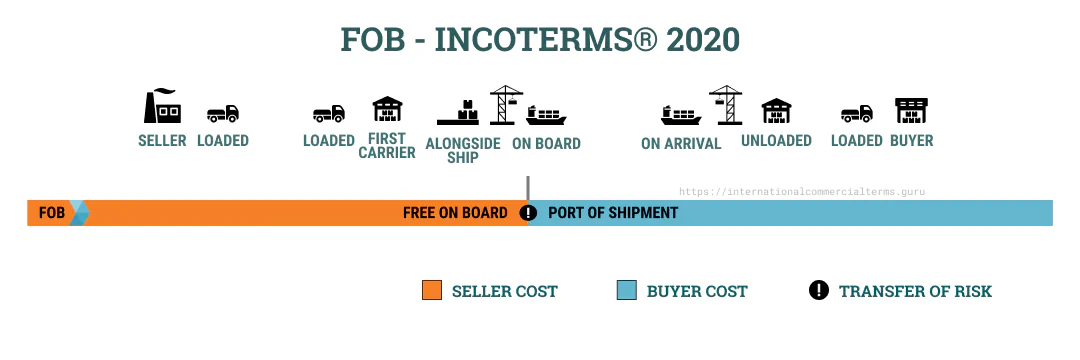
This term was commonly used in the context of the sale and delivery of commodities, whereby the carrier would confirm that the goods had been received on board. When goods are packed in containerized cargo, the most recommended term to use is FCA. This is because the goods will be delivered to the container terminal prior to loading on the vessel. The term is used in the context of commodities such as oil, bulk cargo, and grain. It is common practice to misuse this term when goods are loaded onto a truck. In such cases, the correct term to use is FCA. In an FOB transaction, the seller is responsible for paying the origin terminal handling charge and all other costs associated with moving the goods on board.
FOB is more applicable to bulk cargo than containerized cargo (use FCA instead). FOB can only be used for ocean transportation. The seller’s responsibility ends when the goods are placed on board the vessel. All costs after loading must be assumed by the buyer.
The seller is responsible for export customs clearance and the origin terminal handling charge. This term is traditionally used for bulk transportation, where some cargo can be lost during the process of loading (e.g., grains taken away by wind or boxes dropped in the ocean). It is still the most misused term.
Buying bulk corn:
FOB Valparaiso port, Chile - Incoterms® 2020Buying bulk potatoes:
FOB Port of Cape Town - Incoterms® 2020| THE SELLER’S OBLIGATIONS | THE BUYER’S OBLIGATIONS |
|---|---|
| A1. General The seller must deliver the goods, commercial invoice, and any evidence of conformity. | B1. General The buyer must pay the price of goods as agreed. |
| A2. Delivery Deliver the goods by placing on board the vessel nominated by the buyer at the loading point, in the agreed date or period. In a customary manner at the port | B2. Taking Delivery The buyer takes the goods after delivered. |
| A3. Risks All risk of loss/damage until goods have been delivered | B3. Risks All risk of loss/damage from the time or end of the period agreed for delivery. If the buyer fails to nominate a carrier, or if the carrier doesn’t arrive, the risk is under the buyer. |
| A4. Carriage No obligation to make a contract of carriage. Provide at buyers risk and cost, information for arranging carriage. If agreed, the seller must contract the carrier. | B4. Carriage Contract the carriage from the place of delivery unless agreed the seller will contract the carrier. |
| A5. Insurance No obligation. Provide at buyers risk and cost, any required information. | B5. Insurance No obligation to insure the goods. |
| A6. Delivery/transport document Proof of delivery at sellers cost and a transport document if arranged by seller | B6. Delivery/transport document Accepts the proof of delivery |
| A7. Export/Import clearance All export clearance expenses (license, security, inspection, etc). Assist with import clearance | B7. Export/Import clearance Assist with export clearance. Pay for import clearance and formalities (licenses, security, official documentation). |
| A8. Checking The seller must check, count, weight, mark, and package goods | B8. Checking No obligation. |
| A9. Allocation of cost Pay all the cost until delivery. Cost of proof of delivery. Duties and taxes for export. All costs related to providing assistance in obtaining documents to the buyer | B9. Allocation of cost Pay from the time goods delivered. All costs for assistance on getting carriage, insurance, delivery, and customs documentation. Pay duties and taxes for import or transit. Any additional cost if the carrier is not nominated or carrier fails to collect goods. |
| A10. Notices Give notice that goods have been delivered or the vessel failed to collect the goods. | B10. Notices Notify the vessel name, loading point and time or period. |
No. This is one of the most common misunderstandings in international trade.
Expert explanation: FOB is ONLY appropriate for sea transport where the seller directly delivers goods on board the vessel - such as bulk or breakbulk cargo. It is NOT for FCL (Full Container Load) or LCL (Less than Container Load) shipments.
Why FOB doesn’t work for containers:
What to use instead: FCA (Free Carrier) for containerized shipments.
“FOB Antwerp” is meaningless in the case of containerized shipping. The proper term would be FCA Antwerp for containerized goods.
A port name has many terminals, and containers are typically delivered to a container terminal, not directly onto a vessel. Therefore, the seller cannot deliver goods “on board” the vessel as required under FOB. The terminal operator and carrier control the loading of containers onto vessels, not the seller.
Risk: Transfers from seller to buyer once goods are loaded on board the vessel (whether or not the vessel has sailed).
Ownership: Incoterms do not address ownership. This should be determined by the sales contract. Incoterms handle delivery, risk, and cost.
Control: Would rest with the buyer once goods are on board, since the buyer arranges marine transport under FOB. Marine transport is handled through a shipping line or NVOCC, who would issue the bill of lading to the buyer. Bulk cargo would be handled through a charter party contract arranged by the buyer.